
January 12, 2026
Labs Are Driving More Carbon Than You Think. And That's the Point.
Most lab managers don't wake up thinking about carbon math. You think about uptime. Budgets. Keeping scientists productive. Making sure nothing breaks at 2 a.m.
That's why this matters.
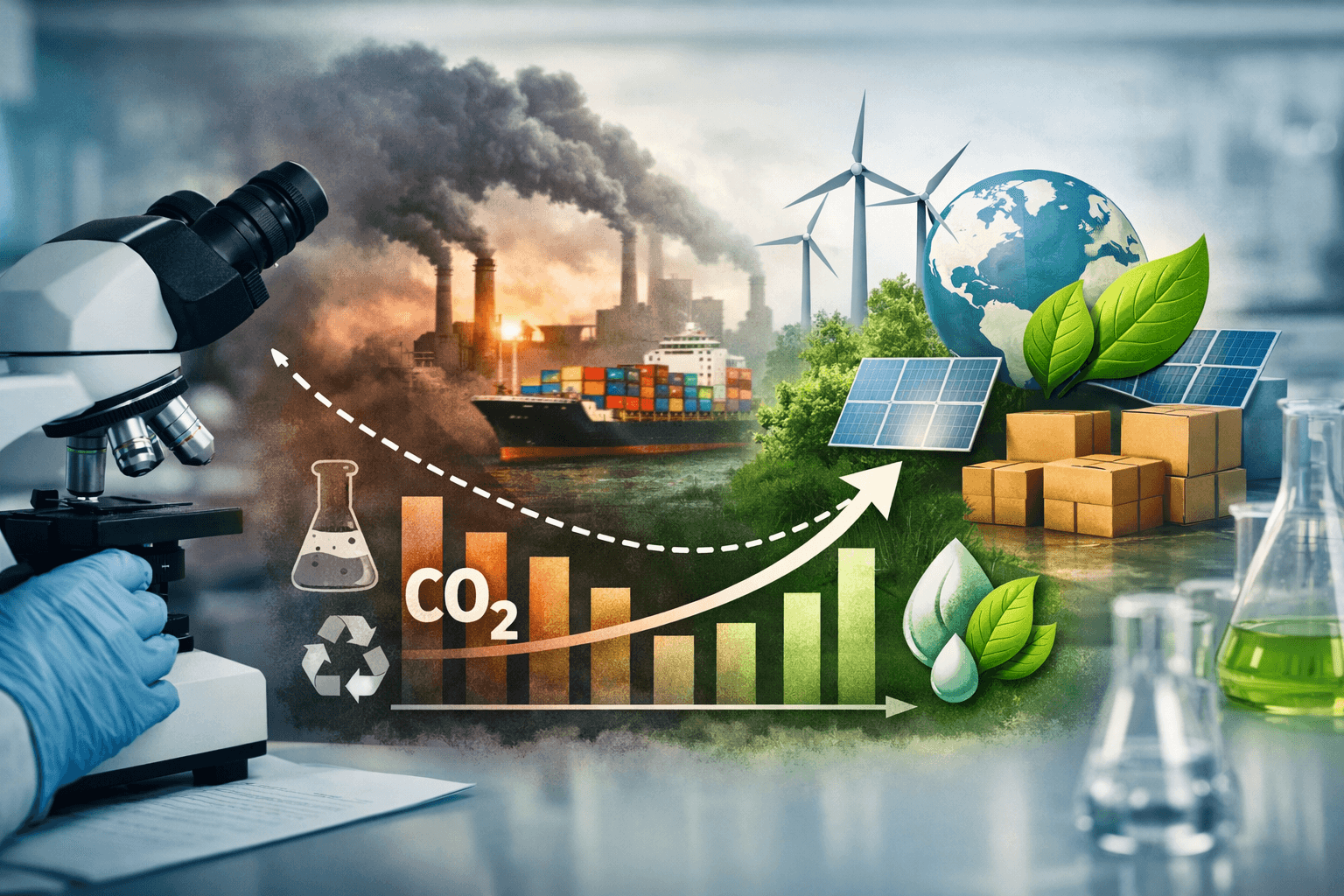
A recent industry report makes something very clear. The biggest source of emissions in biotech and pharma no longer comes from factories or office buildings. It comes from the supply chain. And labs sit right in the middle of it.
This post breaks down what the data actually says. What it means for day-to-day lab operations. And why small changes at the bench matter more than most people realize.
This article draws from LabReNew's companion brief to The Carbon Impact of Biotech & Pharma report by My Green Lab and Intercontinental Exchange.
The real source of emissions isn't where most labs are looking
When people talk about emissions, they usually picture smokestacks or power plants. That mental image is outdated.
Across biotech and pharma, 75 to 88 percent of emissions now come from Scope 3. These represent indirect emissions connected to purchased goods, services, vendors, and contracted work.
Looking deeper reveals specificity: approximately 80 percent of those Scope 3 emissions come from purchased goods and services.
Pipette tips. Reagents. Freezers. Single-use plastics. Contract research. Equipment you never see on an energy bill.
Most labs don't track this. Not because they don't care. Because no one ever told them it mattered.
Now it does.
Why labs carry outsized impact
Labs are not offices with microscopes.
They run hotter. Louder. Longer.
Data from multiple industry sources shows that labs can use up to ten times more energy and four times more water than comparable office spaces.
That's before counting cold storage, fume hoods, autoclaves, or continuous equipment loads.
This explains why lab operations became part of the UN Race to Zero 2030 Breakthrough agenda. It also clarifies why sustainability teams at major pharmaceutical corporations examine upstream partners, including the labs they collaborate with.
If you manage a lab, your operational choices carry visibility.
This isn't only a big pharma problem
Large pharmaceutical companies demonstrate progress. Slowly.
However, the report reveals something uncomfortable. Emissions continue increasing across smaller and private labs, encompassing startups, shared lab spaces, CROs, CDMOs, and academic labs with commercial partnerships.
This matters because these labs operate within supply chains that larger companies face pressure to improve.
If your lab supports discovery, diagnostics, manufacturing, or research services, you're already embedded in someone else's Scope 3 footprint.
Whether that appears in a contract or RFP today or next year depends mostly on timing.
What this means for lab managers, not sustainability teams
Most labs lack a sustainability lead. Or a dedicated budget for this work.
That's fine.
Labs achieving real progress typically begin elsewhere.
They emphasize how the lab actually functions.
Things like:
- Equipment left on when no one is using it
- Freezers colder than necessary
- Fume hoods open by habit
- Water running during cleaning cycles that don't need it
- Disposable materials used out of routine, not need
None of this demands a new department. It requires attention.
And here's what people often overlook.
Labs addressing these issues typically save money. Not eventually. Immediately.
Lower energy consumption. Fewer consumables. Reduced waste disposal. Fewer emergency replacements.
This represents one of those uncommon areas where operational discipline aligns with environmental benefits.
Why early action helps labs, not just the planet
A quiet transformation is underway.
Sustainability questions are beginning to surface in supplier evaluations. In procurement discussions. In partnership conversations.
Not everywhere. Not simultaneously.
However, labs acting early typically land in better positions.
They're simpler to work with. Simpler to defend internally. Simpler to maintain on approved vendor lists.
They additionally sidestep scrambling later when expectations crystallize into obligations.
Being prepared outperforms being reactive.
You don't need perfection to start
A frequent barrier resembles this:
"We're too small." "We don't have data." "We don't want to get it wrong."
The reality is, lab-scale action represents one of the quickest approaches to cutting emissions presently.
Labs demonstrating the largest advances typically accomplish four things:
- Improve everyday lab practices linked to energy, water, and waste
- Embed better habits into how scientists work
- Monitor what they purchase and how often
- Become acquainted with programs their partners already respect
Progress emerges from consistency, not ambitious schemes.
Where LabReNew fits in
This reflects LabReNew's work focus.
Not on vague targets. Not on polished publications.
On supporting labs, particularly under-resourced and early-stage ones, to undertake steps that actually endure.
That usually involves helping labs:
- Recognize why sustainability serves their interests
- Choose initiatives grounded in evidence, not marketing narratives
- Link with initiatives the sector already respects, including My Green Lab Certification and the International Institute for Sustainable Labs Labs2Zero program
- Anticipate forthcoming expectations without expanding infrastructure prematurely
The objective isn't transforming labs into sustainability specialists.
It's enabling them to manage superior labs.
One thing worth sitting with
The trajectory of life science sustainability doesn't depend on a few major enterprises.
It rests on countless labs making modest, consistent decisions daily.
If you manage a lab, that positions you nearer the core of this narrative than presumed.
And that's not a constraint.
It's influence you overlooked.